BLUE TEARS
Patricia Carr Morgan
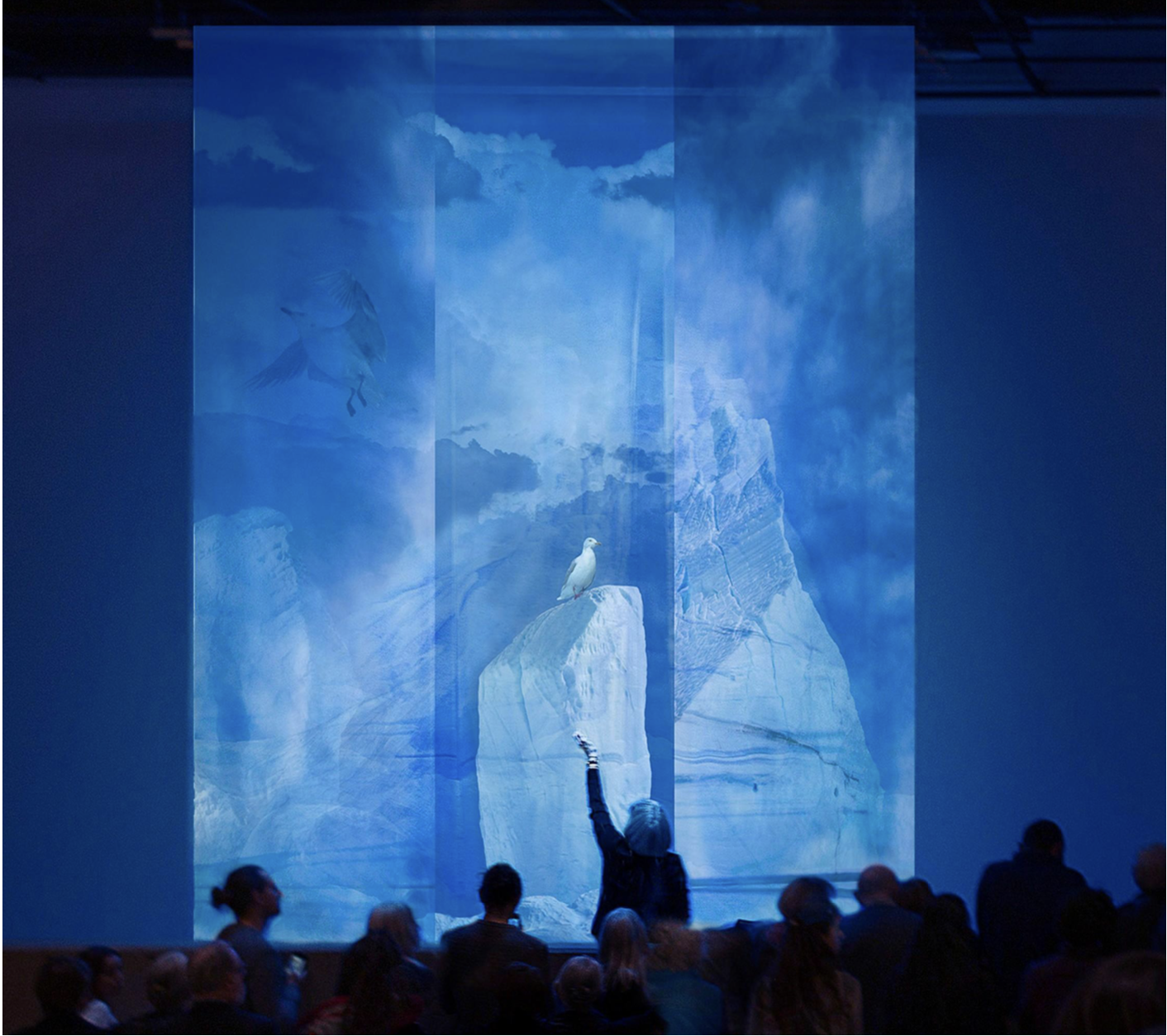
Blue Tears, installation and performance view Tucson Museum of Art, 2019.
Tour Facts
Available Dates
2026 through 2029
Space Requirements
Approx. 2500 sq ft
15ft+ ceiling height
Costs + Support
$2000 contribution toward Shipping/Crating
$2500 Exhibition Fee
$1000 Artist Honoraria
*Sliding-scale available for fees
*Support available to oI-set programming costs
Exhibition Contents
18 silk organza veils printed with photographic imagery, each panel 17 feet tall x 4 feet wide
1 neon sign, approximately 5 inches tall x 5 feet wide
1 mp3 audio file
4 LED light units (installed near ceiling)
Didactics files (optional)
8 framed photographs (optional)
Artist performance (optional)
Contact
Kate Green, Ph.D.
(210) 685-6930 / kateggreen1@gmail.com

Blue Tears is a room-sized installation by artist Patricia Carr Morgan that conceptualizes the drastic scope and emotionality of climate change. The experiential, multi-media artwork—photography, video, sound—revolves around seventeen-foot-tall translucent silk organza veils printed with soaring landscapes composed of glaciers, icebergs, wildlife, and a lone human. Over the course of the exhibition, the veils fall like diminishing glaciers, forming an ocean below. What remains? A single silk panel, suspended with fragile uncertainty.
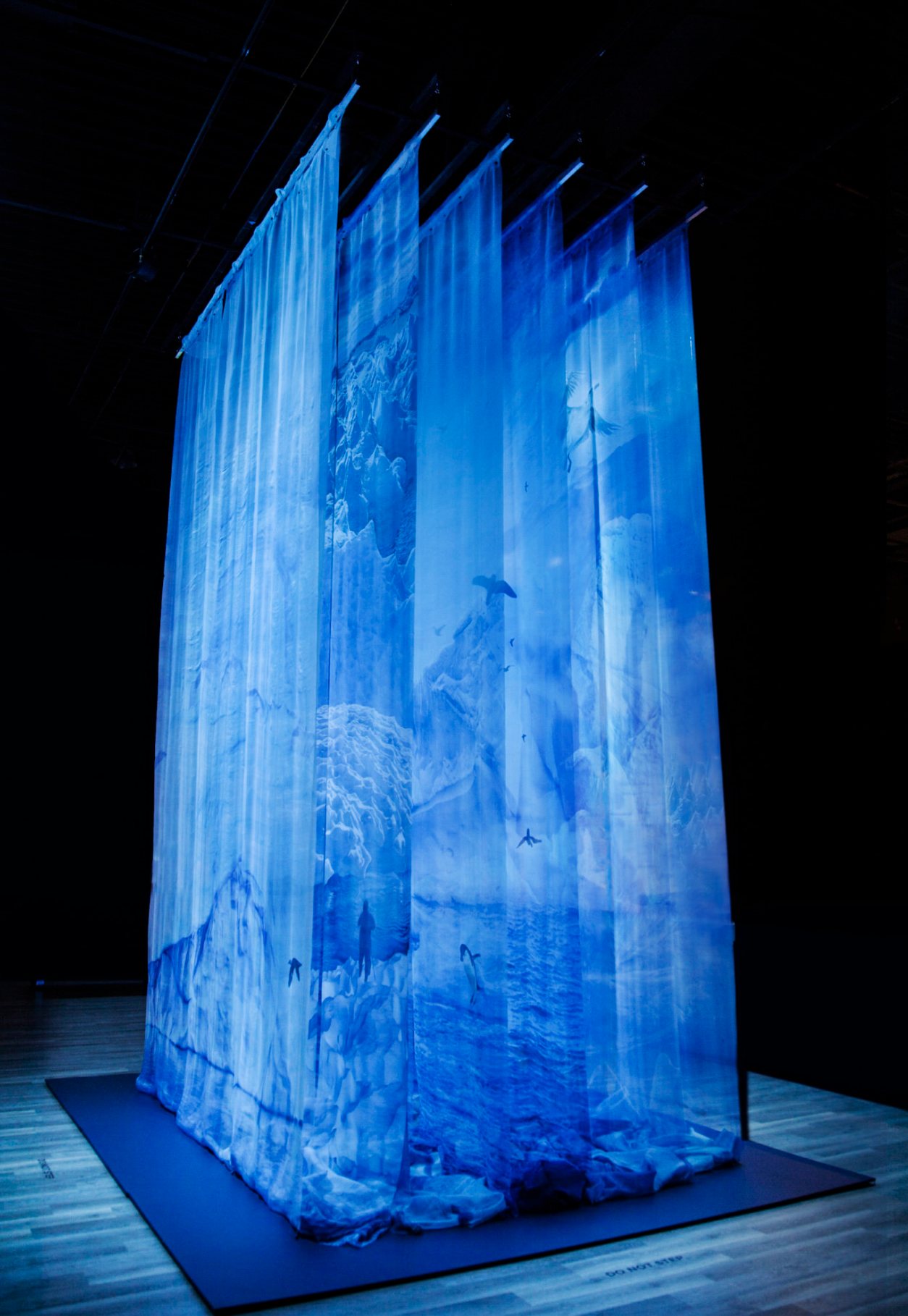

Blue Tears, installation view Tucson Museum of Art, 2019
“I was overwhelmed by the scale of unending whiteness. It was intimidating and dangerous, but it was also the most sublime piece of Earth had ever seen. By then I knew everything wasn’t fine.”
—Patricia Carr Morgan
About the Artist
Since the 1980s, conceptual artist Patricia Carr Morgan has been examining the intersection of time, memory, and place through experiential, multi-media installations. After growing up in the Ozarks, West Plains, Missouri, in the 1970s Carr Morgan moved to Arcata, California, where, as an undergraduate, she studied art history and studio art. She was inspired by artworks that activated viewers physically, and that addressed political and social concerns, from the early Italian Renaissance Brancacci Chapel to the late twentieth century installations of Californian Ed Keinholz. By the end of the ‘70s, Carr Morgan was attaching three-dimensional objects onto her paintings, and soon left canvas altogether. In 1979, the young mother of two moved to Tucson, Arizona. With limited space and time at home, the artist sketched desert foliage and experimented with abstract monoprints.
A crucial turning point came when Carr Morgan began producing large-scale interactive installations, including the discomforting Dinner at Plexi’s, a room-sized Plexiglas enclosure from 1981 lit glowing red, that separated viewers from surrounding floors and walls made of baby bottle nipples, addressing issues of nurturing and deprivation. Pursuing an MFA at University of Arizona, the artist continued exploring photography and three-dimensional artworks that activate eye and body, and that invoke personal experience and universal concerns. Carr Morgan’s work has been presented in many solo exhibitions, including at Tucson Museum of Art (2019), Tampa Museum of Art (1989), University of Southern California (1989), and University of Arizona Art Museum (1988).


Blue Tears, installation view Tucson Museum of Art, 2019
About Blue Tears
The room-sized installation Blue Tears, first presented in 2019, at Tucson Museum of Art, is part of Patricia Carr Morgan’s larger series about the human impact on climate. This series, titled “I love you don’t leave me,” was initiated in 2008, when the artist began photographing the disappearing glacial landscape in Antarctica and Greenland. Blue Tears dramatically evokes the changing environment through this lens, using soaring photographs of glacial ice printed on eighteen seventeen-foot-tall panels made of translucent, environmentally threatened silk organza. The results cast a soft yet haunting light on viewers as they walk around and peer through the expansive landscape, which includes a lone figure overshadowed by ice and Antarctic wildlife. Over the course of the exhibition, the panels fall until one remains, and the exquisite landscape is diminished. A sense of profound awe and loss is evoked by this, and by the sound of a ticking clock and the glowing blue neon sign on the wall that reads “I love you don’t leave me.”

Blue Tears, installation view Tucson Museum of Art, 2019
Artist Statement
Earth is not a paradise lost, but a paradise losing. The line in Anna Akhmatova’s love poem “He Whispers” could describe our dysfunctional relationship to our planet: “either be mine alone or I will kill you.” We have always taken what we wanted from the earth as we marched forward into the twenty-first century. At first we didn’t know what we were doing; we thought the riches of our planet were endless and its survival forever. Now we know we’re a mere interruption in the history of our planet. We know we have broken its balance. The climate we’ve adjusted to over 10,000 years is getting warmer each decade. With our carbon dioxide emissions, we have created a greenhouse we struggle to control but cannot. The glaciers are weeping. Their tears fill the oceans. I’m sorry. My footprint was small and brief, but not without consequence. Greenland and Antarctica, with your glaciers of many blues, your vast whiteness—I love you, don’t leave me.
Select Press
Arizona Public Media https://tv.azpm.org/p/season5/2019/2/25/146851-blue-tears/
Flaunt Magazine https://flaunt.com/content/patricia-carr-morgan
Whitehot Magazine https://whitehotmagazine.com/articles/our-planet-tucson-arizo- na-/4578
Hyperallergic https://hyperallergic.com/a-photographer-captures-the-majesty-of-glaciers-and-their-tragic-disappearance/
artdaily https://artdaily.cc/news/111970/Blue-Tears-exhibition-a-call-to-action-to-stop-globalwarming#YFGENdxlBEYAlthea Magazine, Dusseldorf, Germany https://www.aletheatalks.com/patricia-carr-morgan---it-s-about-a-personal-loss--a-clock-is-ticking